Cache
Harald Theiss, art historian, curator and author
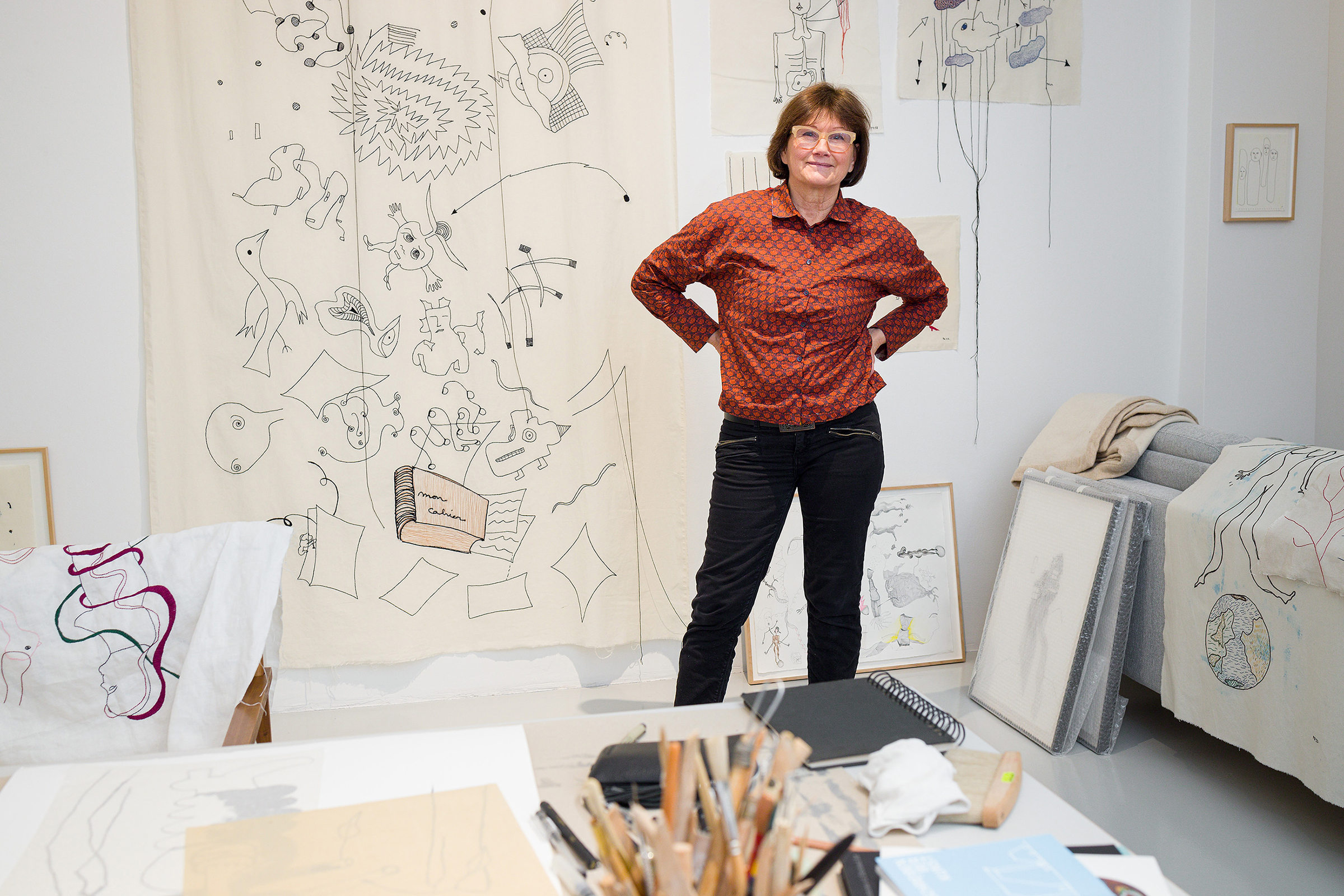
Ambiguity defines the artistic work of Patricia Dreyfus. To this day it remains an almost obsessive and unsparing examination of her own life. Through a surreal vocabulary of forms, she simultaneously reflects omnipresent states of human - mostly female - experiences and insights. The hidden plays a visible role not only formally a visible role. In this context, the title of the exhibition, which can be read in different ways, leads to speculative interpretations. What remains in the textile installation Histoire de ma vie (2018-2022), made up of countless overlaps, is concealed or where does it allow insights? The story of my life, according to the translation, is reminiscent of the autobiographical work of the French writer George Sand. The name is known to be a pseudonym. To this day, it usually serves to conceal identity. The reason was different in Sand's case. With the male name, she adopted the emancipatory habit of speaking of herself in the masculine form...
It is Dreyfus' repeated principle and attempt to create a multi-layered system of order - similar to the (temporarily) stored information or files from the digital cache. In this analogue case, the images from the "background" cannot be fully revealed visually in this analogue case - they remain (for the time being) veiled in the folds. The folding is a structure in which the past is stored, like a geological deposit. But only until Dreyfus herself or the visitors to the exhibition unfold the sculptural "curtain" - layer by layer. Through participation, the work allows Dreyfus to uncover her inner pictorial worlds. One becomes an accomplice in her soul images. The artist works compulsively and not according to templates. Her fantasies impose themselves on her - comparable to the "écriture automatique".
André Breton described this as a process in which writing is steered by thinking without censure or conscious control. On the outside, their imaginary representations remain alien and elude any clear possibility of interpretation, as left behing by Patricia Dreyfus on the fragile and unfinished lines on the fabric. She has recently started to work with embroidery. Knowing her drawings, in which she expressed her unmistakable motifs, it is obvious that the traditional craft of embroidery formerly also referred to as needle painting and which remains more commonly associated with females, can be seen as a consequence of her artistic process. As in the drawings, figuration and abstractions are now sewn into stories. In the textile works they partly disappear in the folds of the fabrics. Or they suddenly make themselves more visible again - seeming to emerge from the surfaces to "reveal" themselves to us completely when the embroidered fabrics are opened. The pieces of cotton cloth offer the artist an almost perfect surface, but not solely as a vehicle for further exploring her artistic craft. The textile material is an intimate and soft fabric, that allows for veiling and can become a second protective skin. As a procedure, stitching is a different physical experience, potentially also more painful. Autobiographical references can also be found in this large-format work. The thread stroke is used in many ways. Over and again, she takes up the themes of female identities, gender relations and sexuality. Naturally associated with this, the role of the mother remains an ever-recurring motif in the most recent works of Patricia Dreyfus – as woman, artist and mother. Similar to Louise Bourgeois’s work Umbilical Cord from 2002, the capacity to give life and the intrinsically related strong corporeal bond to other human beings maintained throughout life are at the same time also an expression of constant vulnerability.
Not only the exhibition is broadened with some mask-like and enigmatic looking heads -. so is the recurring head motif, the so-called têtes. Made out of different materials, it forms a discrete subject within Patricia Dreyfus' oeuvre. Here, too, forms of protection and covering are thematised. Masks and heads have a long tradition in culture and history of art. The human head in particular remains an important pictorial motif in art. This fascination might be based on the fact that we human beings have always considered the head as the key avatar of the spirit and the senses, and in particular of our self. We "wear" masks every day or we hide ourselves in this way. But which faces and thoughts reveal themselves behind them? The title “Ce que disent les fleurs, 1,2,3,4” (2022) suggests hidden references with regard to this consecutive and numbered work. Dreyfus leaves the associative answer and interpretation to the viewers ...