HEADS! HEADS! HEADS!
Dagrun Hintze, Carmen Putschky and Harald F. Theiss
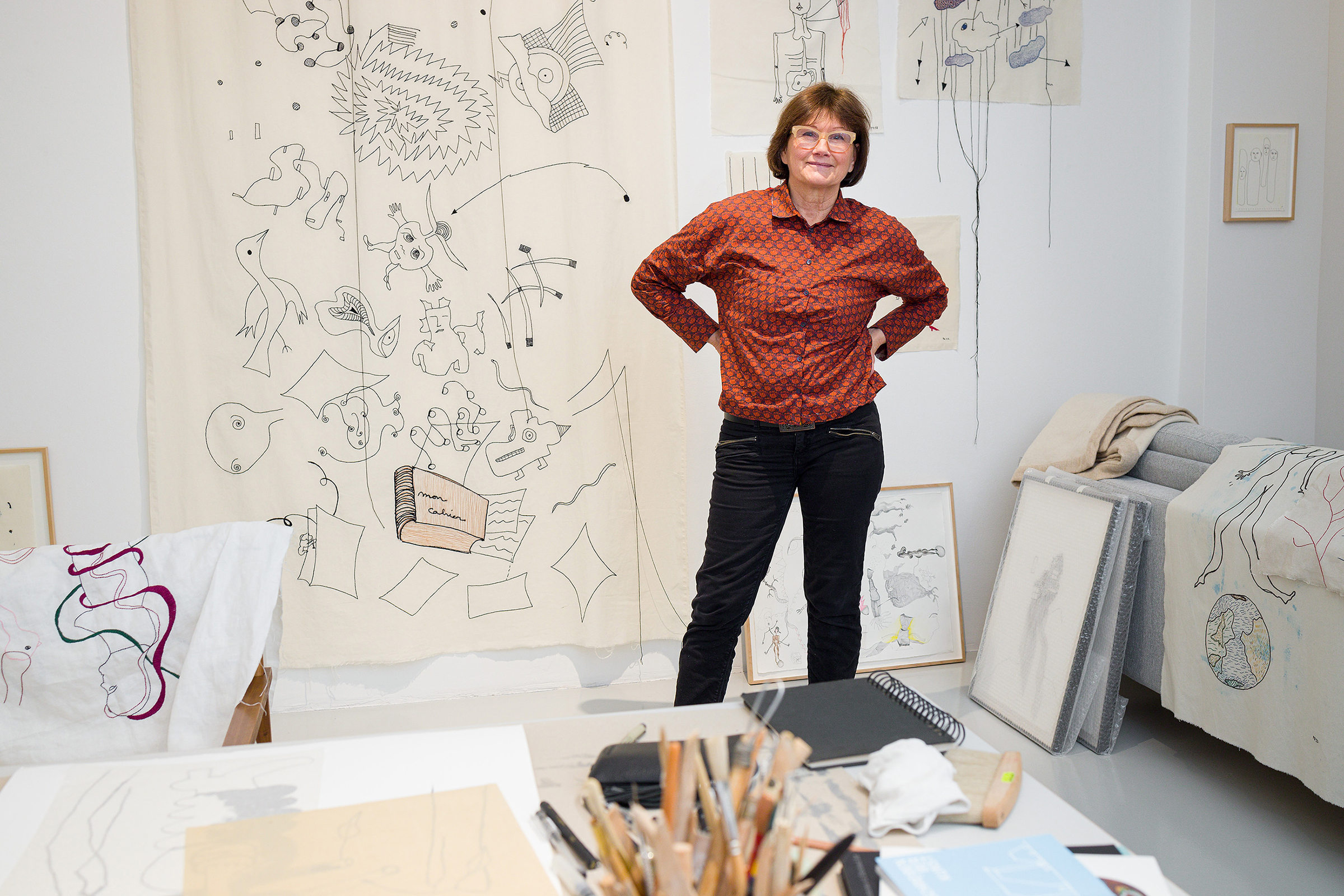
In the work of Patricia Dreyfus, various disciplines converge and complement each other—drawing, sculpture, photography, and embroidery—each medium bringing a unique dimension to her artistic universe. At the heart of her art, drawings mark the starting point, an essential stage where her ideas and creative visions take shape. These drawings, often produced quickly and intuitively, form the matrix of her work, creating linear structures and sometimes surreal scenes where heads often appear...
The small clay heads emerge later, evolving from this graphic work as sculptural elements that enrich and extend her artistic language. These heads, unreal and created instinctively, reappear in her photographic series and installations, serving as recurring motifs and vehicles of meaning. They are central to her exploration of the abstract and surreal, inviting viewers to dive into Dreyfus's unique universe.
The sculptures vary in colour and texture: the fragile, organic terracottas contrast with the smoother, colder bronzes. Both are transformed by heat, moving from a malleable state to a permanent one, reflecting the tension between temporality and durability.
Since 2018, Dreyfus has expanded her explorations by incorporating embroidery, a medium that allows her to delve deeper into her imagination while highlighting the complexity of human experiences. Her photographs in turn stage her sculptures in specific contexts and offer viewers new and fascinating perspectives.
In her pictorial work, the unpredictable plays a fundamental role in her pictorial work, structuring her entire oeuvre and expressing itself without constraint. Symbolic elements condense into enigmatic settings, suggesting inner worlds inhabited by the artist's unique psycholinguistic imagery. These are imagined realities, haunted by memories, personal stories, and mental and physical experiences.
Through this multidimensional exploration, Dreyfus confronts the fantasies and abysses of the subconscious, the appropriation and loss of the world, invulnerability and fear, redemption and pain. She approaches the inherent tension in the ambivalence of human existence with lightness, discreet irony, and humour, creating works that elegantly distance themselves from the dominance of the unconscious and its vulnerabilities.
Based on Dagrun Hintze, Carmen Putschky and Harald F. Theiss