Insomnia
Benteli | 2011
Being cursed with sleeplessness, Emile Cioran wrote, is “an extremely painful experience, a catastrophe. But it allows you to understand things that the others cannot understand: sleeplessness puts you outside the living’s domain, outside humanity.”
What medicine nowadays seeks to combat with drugs and sleep laboratories has to many artists always acted as a spur: they would spend whole nights awake and use this painful but equally lucid condition to pursue their work. It’s probably no different for Patricia Dreyfus – “Insomnia”, at any rate, is how she has chosen to call the survey of her work presented here. It is also the title of one of her drawings. Almost as if suspended in mid-air, a window signifies an interior space in which a bed is seen standing on a ground that is hard to identify – a carpet maybe? A large puddle? Or the haven reserved for sleep and dreaming to which the male figure on the paper fails to gain access? The bed is not rooted in a fixed place, but is fitted with wheels rather than legs. The male figure has attached some kind of harness to the bottom end of the bed and can be seen dragging it away at a vigorous pace. Whether the enigmatic ground will shift with the bed or stay behind on the same spot is left to the viewer’s imagination. Anyone who has been plagued with insomnia will be familiar with the idea of changing location in the hope of perhaps finally finding sleep somewhere else. So a mobile bed which can be pulled around and relocated as one fancies would make an apposite piece of furniture for all insomniacs. At the same time, the bed’s function is also reversed. It is supposed to be a place where people can retreat, find peace and shelter; yet here the bed takes on a life of its own, has to be put on a leash like a dog and “tamed”. The bed is not there to serve human needs, it challenges us to highly exacting interaction. This is how the victims of insomnia feel – Patricia Dreyfus’s drawing offers a gentle, cheerful expression of an inner condition which may cause loneliness and anguish but can also act as a motor for creative work. A man who hauls his bed behind him is someone we could altogether imagine being a performance artist.
The insomniacs’ involuntary “bright nights” cannot be compared with the normal waking state during the daytime. Sleeplessness engenders an intermediate state in which dream and reality merge and fantasies and phobias acquire a compelling power, in which poetry might offer an anchor of stability. The rational control exerted by daytime consciousness becomes unhinged, the subconscious and repressed urges break loose – exactly as the Surrealists had hoped for. “Pure psychic automatism” was how André Breton defined the art of Surrealism. Techniques such as “automatic writing” or “automatic drawing” could trigger this automatism, channels for an unintended and spontaneous expression of the artist’s subconscious who surrenders control over a text or a picture and grants accident an actively creative role. Patricia Dreyfus still employs these techniques, although – now almost ninety years after the Surrealist Manifesto – she of course arrives at different artistic results.
Her work is a fusion of several disciplines – sculpture, drawing and photography – whereby no one of these alone would be conceivable without either of the others. Dreyfus’s sculptures, for instance, crop up in her drawings and her photographic series, emerging both as elements of composition and vehicles of meaning. The themes the artist explores are always apparent, whichever medium she uses. They address the fantasies and chasms of our subconscious, deal with our assimilation of the world and our sense of loss, speak about invulnerability and fear, atonement and pain. In other words, her work plumbs the charged field of ambivalence that she evidently identifies as the basic condition of human existence. Patricia Dreyfus frequently treats this underlying tension with lightness, understated irony and humour, creating works that with calm aloofness dismiss the supremacy of the subconscious – something the Surrealists would have considered inconceivable: insomnia gives way to poetry that is as bright as day.
Heads
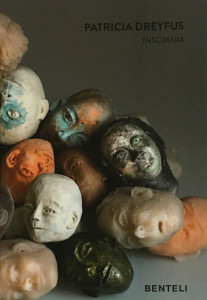
Small heads modelled in clay form the hub of Patricia Dreyfus’s work. Wherever she goes, she takes moist clay with her, allowing her – in the manner of “automatic sculpting” – to create new heads on the spur of the moment. In recent years she has crafted over a thousand of these tiny sculptures. She never bases them on “real” human faces, yet these modelled effigies come across as lifelike portraits of actual people of the most varied provenience. It is a paradox we are already familiar with from the sculpture of antiquity, whose fictive portraits largely bear the most strongly individualized traits. By using clay of different colours to make her heads, Dreyfus not only heightens their self-evident, direct impact but also withdraws them from the viewer’s frame of reference. In a mysterious way her sculptures appear to have slipped through the fabric of time: they could equally be mistaken for relics from antiquity or artistic products of classical Modernism or even contemporary art. Some of the clay heads also serve as forms for making moulds. She then casts the sculptures in silicon or bronze, imbuing them with a different aura by means of the material. In bronze they appear to have been made for eternity, fictitious miniature monuments that are still waiting to meet their human likenesses. Cast in transparently clear or uniformly dyed silicon, they are reminiscent of anatomy models. Here, the focus lies less on individual traits than on their phenotypic character – the human being in all variations of its “outward form” is now officially cleared for investigation and research.
Patricia Dreyfus’s sculpted heads can be grasped as friendly companions, as protective talismans. At the same time, they also call to mind fetishes and voodoo magic. The artist constantly exposes her heads to different situations: she plants them into everyday surroundings, outside on the street, in open nature or in hotel rooms, thereby creating puzzling, occasionally even absurd or seemingly axiomatic constellations. Art is pitted against reality on an equal footing, giving rise to something one might call a “third order”. In addition, the artist assembles large numbers of heads to form installations suggestive of mass graves, or combines them with commonplace items, found objects and texts to create mises en scène in boxes – small stages as settings for the enactment of the kind of intimate psychoanalytic theatre that would have given pleasure not only to Daniel Spoerri. Dreyfus occasionally seals the heads inside jars as if she were building an archive whose profile – anatomical, psychological, artistic – is to be decided by the viewer. Throughout her work, however, she unerringly upholds the ambivalence at the core of in the sculptures’ impact. This ambivalence harbours a condition that Sigmund Freud perceived in the “uncanny”, the constant presence of something deeply familiar.
Portraits with heads
Especially familiar to Patricia Dreyfus are the people she has portrayed in her most recent photo series of “Portraits with heads” – members of her own family and close friends. Asking her subjects to choose which and how many of the sculpted heads they wished to be accompanied by, the artist left the decision entirely up to them. She observed how much the expression and the posture of her models changed once they were holding one or several heads in their hands, as if some mysterious interaction between the model and the sculptures had been struck up in which she as the photographer was also included. During the shoot her family members and friends were instructed to think of “nothing”. The pictures were all taken in natural light (near a window) and not post-processed.
The mood in these images is very earnest; the subjects conceal nothing before the camera, confronting the viewer with their immediate, self-assured gazes which project, indeed thrust, their individual stories out “beyond the frame”. In this photo series Patricia Dreyfus appears to be exploring the deeper meaning of family, in a broader sense that also includes friends, and how, over and again, these individually discrete subjects end up constituting a community. The small terra cotta heads act as a bridge and, at the same time, serve as mediators between the viewer and the portrayed subjects – as if they too belonged to this community, as if they were plying the human models with crucial questions. They could be imagined as the forebears of the portrayed individuals, wielding influence far beyond their own lifetimes. In the encounter with a pregnant woman, however, they directly address the future. In each instance, they shield the portrayed subjects from loneliness; their very timelessness more emphatically locates the people in the photographs in a concrete here and now.
Drawings
Of course, the small heads also crop up as a motif in Dreyfus’s drawings. They can be seen emanating from the skull of the “Woman with cut-off arms” like antennae, transforming the figure into a strange extra-terrestrial being capable of observing the world simultaneously from a myriad of different perspectives – whereby one of the heads has already dropped from its stalk and seems in the process of becoming “autonomous”. In “Voraciousness” a man viewed in profile is just about to swallow a small crowned head. Maybe he is simply inhaling somewhat too vigorously – in any case, he is on the point of ingesting the tiny defenceless king. In “Dawn trapped” a bottle is packed with heads, with one head acting as a stopper; by thus acquiring a face, the bottle is transformed into a living being. Indeed, hybrids seem to hold sway in the graphic world of Patricia Dreyfus’s drawings. Human faces are fused with objects, human bodies merge into architecture. In “Removal” a woman is shown proceeding on all fours, with her hands inside a pair of high heels and an entire building planted on her shoulders where her head is supposed to be, smoke billowing freely from its chimneys. The drawing shows female identity in a state of evident confusion; performing her various roles as the caring wife, the seductive lover and – in drastic expression – the submissive domestic pet culminates in a mental and emotional blackout.
Patricia Dreyfus is driven by an inner imperative to make marks on paper, draws like other people keep diaries. She constantly orbits around motifs relating to female identity, sexuality and vulnerability, but which also manifest female strength: “Attachment” shows a naked woman nailed to a cross, a nipple on a breast serving as a mound supporting the cross. Although dismembered hands can be seen reaching out to touch her, the crucified woman does not give the impression of someone unduly suffering. On the contrary, with an assured and almost cheerful countenance she appears to have come to terms with her situation.
These “automatic drawings” – which to some extent the artist later combines and digitally modifies – generate their own dream (or sometimes also nightmare) logic which the viewer can “tap in to” in a freely associative manner. Her appetite for pictorial puzzles, which the viewer will never fully “solve” or paraphrase with language, is a quality she shares with other female artists of the 20th and 21st century. Among them, in terms of their choice of themes and linear rendition one could certainly cite Louise Bourgeois and Tracy Emin as “sister spirits” of Patricia Dreyfus. Shortly before Bourgeois died, she and Emin began a joint project. Bourgeois painted gouaches of male and female torsi, around which Emin added her own small drawings that, uninhibited by fear, speak of love, pain, desire and loss. One prominent feature of this collaboration is the age gap between the two artists: Bourgeois and Emin were separated by more than fifty years; the older woman’s art (similar to that of Patricia Dreyfus) is rooted in psychoanalysis; the younger woman’s art is couched in the controversial hipness of the Young British Artists. None of these three artists could be termed as explicitly “feminist”. Yet they each pursue a questioning of female identity and vulnerability, of the interaction between the sexes so frequently defined by abuse of power, of hidden psychological and biographical depths that are surmounted with humour and poetry. Such questioning continues to be as timeless in its imperative necessity as ever before.
Dagrun Hintze, 2011 I Translated by Matthew Partridge