L'imaginaire of islands and other phantasms
Text von Harald F. Theiss
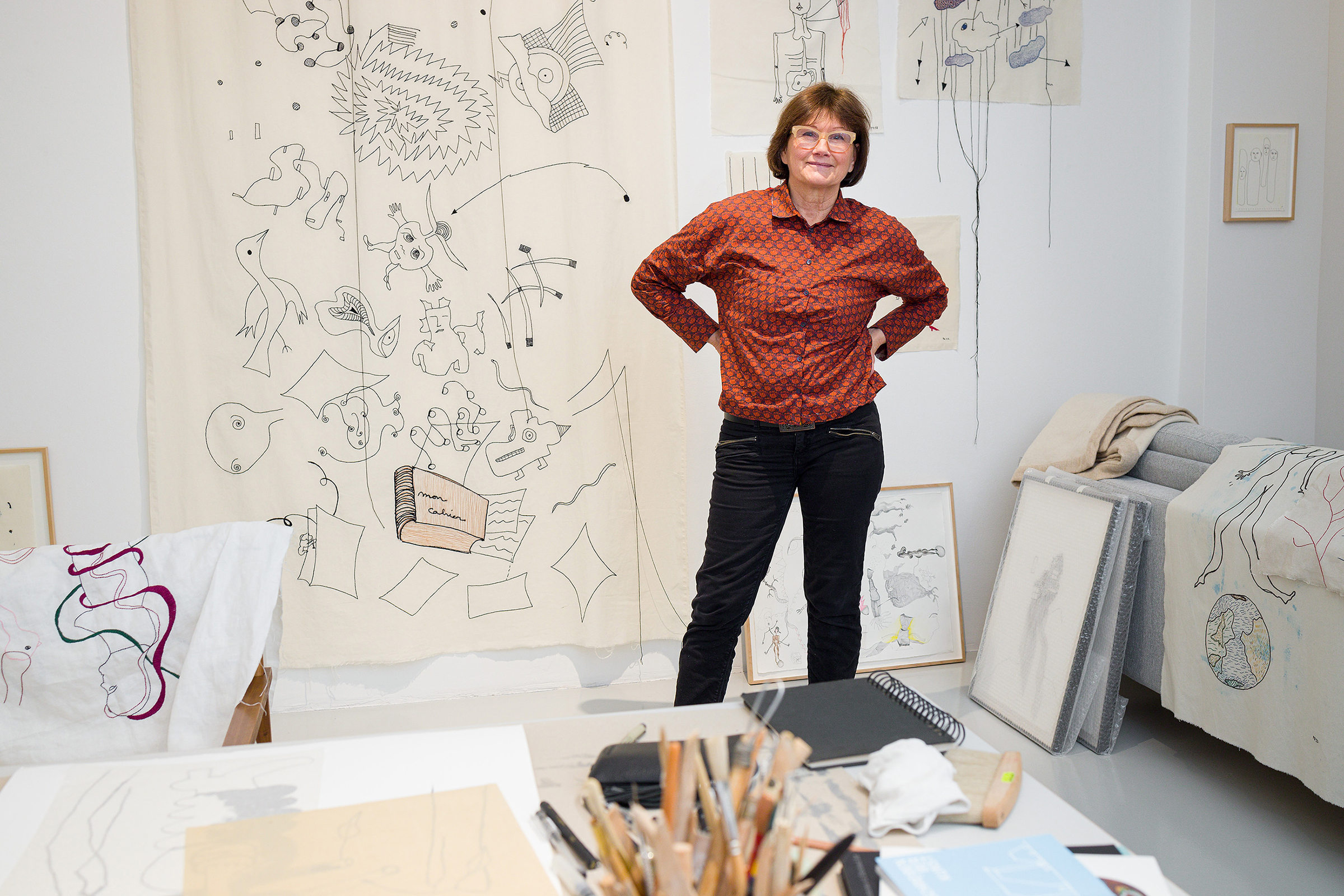
The title of the exhibition refers, among other things, to the history of the term "l'imaginaire" as a non-place of being and can be translated as only thought, imagined, not real, or existing only in the imagination. At the same time, "Imago" in Latin means image. Used in surreal texts of the 1920s, the term can be found as early as 1908 in Rainer Maria Rilke's collection of New Poems, where at the end of the sonnet "The Flamingos, Jardin des Plantes, Paris," there is mention of stepping into the imaginary, leaving behind an unknown dimension: the fantastic merges with the real. The imagery, as described, is influenced by Rilke's time in Paris and his engagement with visual arts, particularly with Paul Cézanne and August Rodin...
From today's perspective, the appeal of the term lies in its openness—linked with an almost inexhaustible turning towards constructions of personal mythologies. Dreyfus, in her drawings, embroideries, and tapestries, narrates of a second mysterious reality with almost lyrical images. In oneof her text-images, she writes: "I let myself be carried away by my imagination... We all carry within us our imaginary islands." Transported by one's own imagination, their fantastical image contents can initially be located beyond conceivable experience. Behind the enigmatic events lies a longing to find explanations for the rational within the irrational. Between magical realism and surreal artistic actions, Dreyfus invents fictional places: imaginary islands. Magical moments always create a changed awareness of our environment. Her artistic metaphors are accompanied by texts she writes alongside them. This inner dialogue between visual and textual language also raises questions about the essential in self-reflective reception. Initially reminiscent of the characteristics of Pittura Metafisica, a movement also influenced by texts about the supernatural, the content is marked by inexplicability and mystery, aiming less to paint in a certain way than to observe in a certain way—a stimulating concept for the subsequent Surrealist movement, a cultural movement famously expressed itself as a way of life and art against traditional norms since the 1920s.
In "l’ I M A G I N A I R E, von Inseln und anderen Phantasmen," a fantastic space opens up, both in front of and behind Dreyfus's new tapestry works. In fictional literature, islands are not only the universally familiar, often distant dreamlike places of longing, but they are also threatening in their solitude. It's no wonder that the saying "No man is an island" is used when referring to social structures without which humans can hardly live. Dreams not only serve in literature as an epic foreshadowings but also offer insights into future events within the plot. It seems that Dreyfus unconsciously experiments with these and other ideas, leaving the islands of happiness as fiction. Created for a presentation in Brussels, two tapestries from the cycle L'Îles imaginaires are shown in relation to her drawings and embroideries from recent years.
Textile art is intertwined with human history and has long ceased to be considered as merely dusty tapestries. The once representative and magnificent art of tapestry has recently awakened to new narratives. The (abstract) motifs changed with the threads woven into modernity and later shifted towards socio-political connections over time. New textile historical images have emerged, addressing humanity, nature, and life in general: woven manifestos like those of Anni Albers or Hannah Ryggen. The original form of communication remains preserved to this day. Dreyfus has further developed her surreal formal language coherently. She follows uncontrolled rules, even in the translation of her inner images into various textile production processes. These are self-reflections through which she observes events from a certain perspective, commenting on or even questioning forms of humanexistence. In Jacques Lacan's theory, the "Imaginary" is a place of self-recognition and self-portrayal, but also a realm of desire and fantasies.
The informational content and interpretation are left to the viewers. According to the artist, an inner need and the unpredictable play a decisive role in finding the imagery. It shapes her entire body of work, stemming from the so-called state of "insomnia" and expressing itself somewhat automatically and uncensored. As early as the time of historical Surrealism, the subconscious and dreams were used as creative sources. Dreyfus's imaginary depictions of fabulous human and animal forms are mysterious and symbolically charged: scenes with trees and birds, houses and cages, or snakes condense into creative worlds. Automatic or almost involuntary, because the artist works compulsively and not from templates. Her phantasms impose themselves on her. They are comparable to "écriture automatique." André Breton described this as a process in which writing follows thinking unfiltered and uncontrolled. This is best achieved in the state of half-sleep at twilight. Breton wrote: "Those whohave not tried this themselves will have difficulty imagining it more precisely."
The newer Surrealism is feminine, a notion that has only recently been acknowledged, although "fantastic" women have been shaping art with surreal imagery since modern times. Presently, there is a renewed schift towards surreal concepts. While historical Surrealism was once a "cry of the spirit returning to itself", today's artistic positions are more relaxed towards this ambivalent state of tension in the face of overwhelming forces and approached from a more awake, fearless perspective.
Nevertheless, traces of unease are still visible. With Dreyfus, they lead into the unexplained. Her incomparable dream images cannot be copied.
Text, Harald F. Theiss
1 Johannes Ungelenk, Rainer Maria Rilke's "The Flamingos" A Kling(- ge-)ding, 2017, in Hofmannsthal Yearbook on European Modernism, pp.163-192.
2 See Peter Widmer, Subversion of Desire: An Introduction to Jacques Lacan's Work. Turia + Kant, Vienna, 1997.
3 André Breton, The Manifestos of Surrealism, translated by Ruth Henry, Reinbek bei Hamburg, 1968, pp. 11-29.
4 Fiona Bradley, Surrealism, East Fliedern, 2001, p. 6.