Lettre à moi-même
Harald Theiss, art historian, curator and author
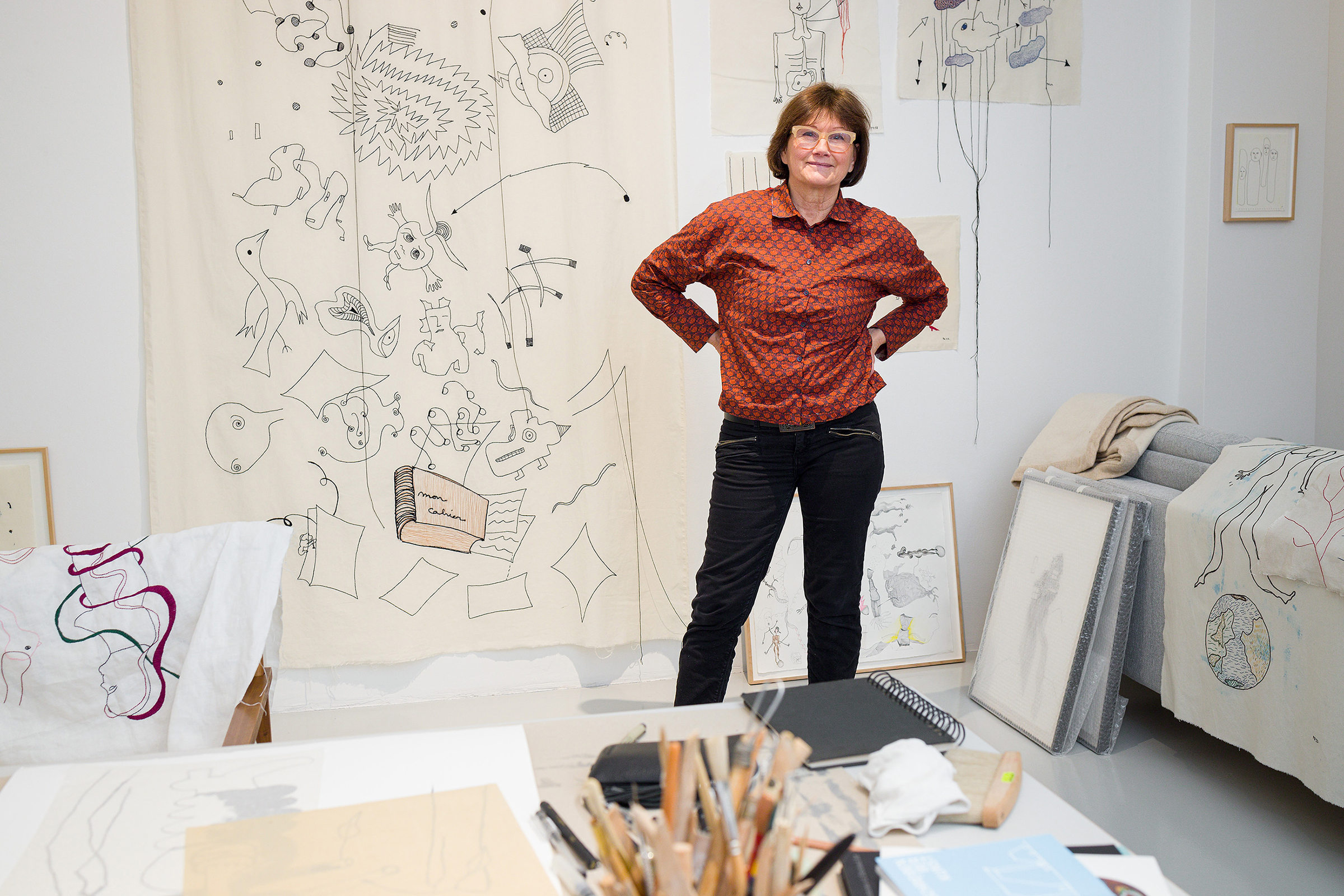
Lettre à moi-même is a project in several parts by Patricia Dreyfus, a French artist living in Berlin. It is an almost immeasurable personal cosmos of surrealistic stylistic elements that is manifest throughout her cross-genre work. At the hub of this largely figurative narrative is an autobiographical context. In this way, not only does she offer insights into this context but also provokes unmitigated involvement with it. Questions concerning origins, identity and gender are addressed – yet the focus lies on breaking through and breaking open boundaries, social norms and constraints...
This in fact is not a letter Patricia Dreyfus is writing to herself – rather, she is appropriating a linguistic system based on surreal (visual) signs. In this way, she uses artistic means to further develop a taxonomy that at the same time obeys its own, unrestrained rules. She leaves it up to the viewers as to how the levels of semantic and thematic content might be interpreted and perceived. As the artist tells us, her pictorial invention is driven foremost by inner necessity and serendipity. The unpredictable shapes her entire oeuvre: it is fostered by the state of what is known as insomnia and, in a certain manner, finds expression automatically, without the interference of censorship. Dreams and the subconscious had already been tapped as a creative source in Surrealism. Dreyfus’s imaginary depictions of mythical creatures, human figures and animals are enigmatic and symbolically charged: scenes showing trees, houses, cages, crosses, birds and snakes evoke dream sequences (as in L’Île imaginaire, 2017, nos. 2, 16, 39). Automatically, or of their own accord, since Dreyfus’s work is propelled by compulsion and not derived from source material. Her phantasms suggest themselves to her. They are comparable to the Surrealists’ “écriture automatique”. André Breton described this as a process in which writing is steered by thinking without censure or conscious control. This is best achieved in an intermediate conscious state on the verge of falling asleep during twilight. Of this process Breton remarked: “Anyone who has not himself tried to take this path will find it very hard to picture it more precisely."
The new Surrealism is female, as was recently claimed, even though “fantastical” women artists have been shaping art with their surreal pictorial worlds since the beginning of Modernism. Currently, one can observe a resurging tendency towards Surrealist concepts. Whereas historic Surrealism was still “[…] a cry of the mind turning back on itself”, in present-day approaches to painting and artistic production this ambivalent state of tension incurred by subconscious forces is encountered largely with greater calm and from a more vigilant, less anxious perspective. Nonetheless, there still remain traces of disquiet – especially in the artist’s strikingly figurative scenarios and, above all, in her most recent paintings which show fictional accomplices joining forces with an anonymous post-digital generation.
Lettre à moi-même #3 shows recent works by Patricia Dreyfus, and is at the same time an attempt to get closer to her oeuvre of dreamt reality. It bundles together in fresh constellation her coloured drawings from the group of works titled L’Île imaginaire (2017) and not only juxtaposes them with her embroidered pieces, but also initiates a dialogue with the extensive series of Les Invisibles from 2020, works on paper she produced on an almost daily basis during society’s comprehensive standstill over the past year. Once again, we encounter more of her têtes, now drawn, an ever-recurring motif. Within the ensemble of Dreyfus’s work these heads represent an artistic subject in its own right. As such, the human head has always been a central pictorial theme in art. This unceasing fascination might lie in the way we human beings have always seen the head as the paramount embodiment of the spirit and the senses, and in particular of the self. These heads modelled in clay and bronze have a raw and archaic feel, bringing to mind the miniatures displayed in glass cabinets in ethnological museums (Tête 0051 en boîte, 2019). In their quantity, Dreyfus’s new diminutive drawings of heads quickly foster their own constructed mythology. More clearly defined in terms of individuality are their various facial expressions. She compares them to life companions whose mysterious company she gladly shares. Drawn with seemingly just a few lines, the heads feel like portraits of human characters she might have met somewhere at some time.
Kinships become visible, over and beyond those between the various artistic media. Where one was still speculating about the numerous heads in Les Invisibles because they remind us of protagonists or even contemporaries in an imagined world, Patricia Dreyfus’s embroideries strike us as far more intimate and radical. Her oeuvre is deeply influenced by the artist’s life and can be “read” as a kind of richly referential journal. Much remains alien, thus eluding all possibility of unequivocal interpretation. Clues are left in the present by (corporeal) signs. A hidden sense. Here, what is concealed plays a visible role. Dreyfus turns a lot inside out. Her dogged perseverance is unique. Just like the state of uncertainty in several of her “unfathomable” scenarios with their constantly varying density that represent everyday situations marked by fragility and a lack of orientation. Her distinctive motifs, predominantly female figures, are drawn or embroidered, a technique with which she has only recently began to work. To those familiar with her drawings, it makes sense to view a traditional craft of this kind – which also used to be called silk shading and even today is still considered a predominantly female activity – as a logical consequence of her artistic practice: stitching as rebellion. Her embroideries do not create patterns or ornaments; but certainly inscriptions: I will survive is stitched onto one of her pieces from 2018, and can be read almost as a public statement.
Dreyfus is not interested in precision or attention to detail; instead the lines she leaves on the fabric are brittle and fragmented. As in her drawings, figuration and abstraction are woven into stories. In some of her textile works they partially disappear into the folds thrown by the fabrics (as in Haute-cour, 2018). In others, they suddenly make their presence felt more forcefully, become visible again and appear to stand out from the surfaces – only to fully “unveil” themselves the moment the fabric is unfurled (Le cri, 2018). The pieces of cotton cloth offer the artist an almost perfect surface, but not solely as a vehicle for further exploring her artistic craft. As a procedure, stitching is a different physical experience, potentially also more painful. We can also detect autobiographical references in these works. Here, she makes multiple use of her stitched line. Over and again, she takes up the themes of female identities, gender relations and sexuality. Naturally associated with this, the role of the mother remains an ever-recurring motif in the most recent works of Patricia Dreyfus – as woman, artist and mother. Similar to Louise Bourgeois’s work Umbilical Cord from 2002, the capacity to give life and the intrinsically related strong corporeal bond to other human beings maintained throughout life are at the same time also an expression of constant vulnerability.
Herein lies one of the outstanding aspects of Patricia Dreyfus’s work whose narrative is related through complex and, at times, disconcerting images, frequently peering into impenetrable depths. Hence the question: consciously or not? Her dream images move us and allow us to participate in states of mind that evoke both shameless candour and simultaneous fragility, thereby prompting a range of different responses. Symbolic elements are condensed into enigmatic settings suggestive of interior visual worlds shaped by psycholinguistic imagery. This is a disconnected (imagined) reality haunted by memories, personal history, experiences and insights.
Patricia Dreyfus’s multi-faceted artistic work, in which the principle of reiteration constitutes a unifying element, continues to be an almost obsessive and unsparing confrontation with her own life, her Histoire de famille, as one of her drawings from 2018 is titled. Her life is the engine of her artistic energy, and yet with surreal visual means she also reflects on the ubiquitous and universal conditions of human – and specifically female – experience and understanding. In doing so, she achieves a balance between uncompromising directness and sensitive observation. In a process of abstract subjectification Patricia Dreyfus channels her personal experiences and thoughts through the transformation of the subconscious, but without fully abandoning touches of irony.
This is about more than simply governing her dreams – at best it is a yearning for more life…
Berlin, 28.03.2021 I Translated by Matthew Partridge