Suspended
Dr. Carmen Putschky
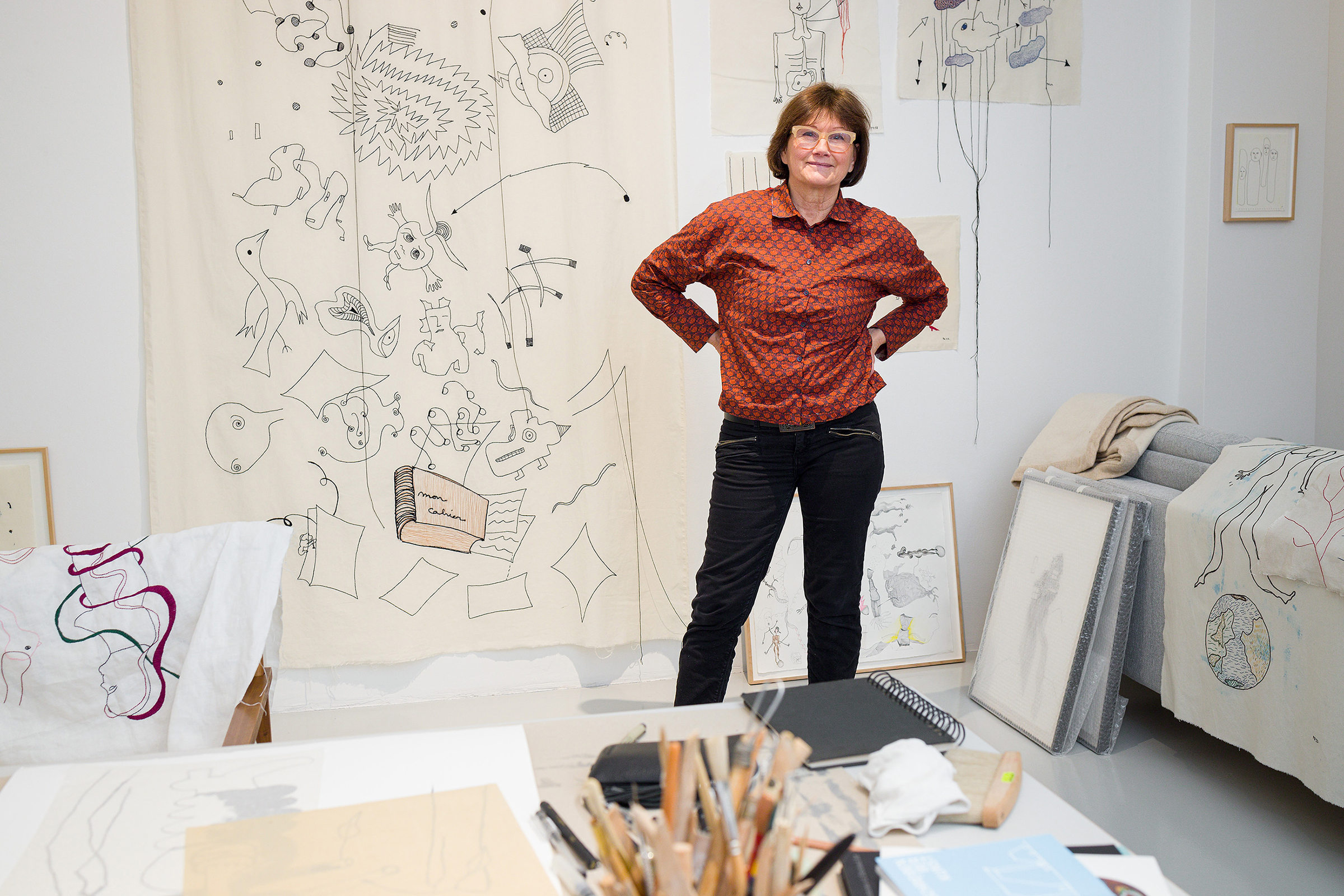
A long, transparent fabric, 160 cm wide and 500 cm long, hanging down, attached from the ceiling spreads accross the room. Attached to it are small, light-coloured rectangles of cotton fabric, carelessly applied, some of the corners hanging down a little. This gives them a sculptural effect, playing with light and shadow, not quite visible...
At the same time, they are arranged symmetrically on the transparent fabric - there are 50 fields in four horizontal and nine vertical stripes. This regularity is lost on the floor - the rectangular pieces of fabric are now laid out carelessly and as if at random. They take up space beyond the edge of the hanging, transparent fabric. In this floor area there is a small plaster model on the fabric. It is universally recognisable as the simple shape of a house. Starting from this, red threads run across the surface towards the rectangles distributed on the floor. The result is a tangle of lines whose direction of movement cannot be determined. The house symbolizes the personal centre, the matrix. It appears inaccessible, intact. From there, there is a network to and from the pictures, i.e. in a figurative sense to the experiences. This arrangement stands for each person's individual life paths. The intertwined red threads point in different directions and are reminiscent of pulsating blood vessels. The rectangles have an embroidered linear black frame. They also contain embroidered graphic motifs in black, red, pink and orange. The motifs are female figurative representations - sometimes a head, sometimes a shape that only resembles a woman's body, sometimes concretely recognisable figures. Often there are only hints, sometimes it is more specific, always enigmatic and surreal. The female figures are presented in various states: in pairs or alone, upside down, standing or lying down, pregnant or giving birth, sometimes they become metamorphotic beings. They often display certain key stimuli such as red, high-heeled shoes, mouths, breasts and vulvas. The images suggest the telling of a story - each individual image tells something and all of them together form a sequence of images.
The entire installation appears almost immaterial - transparent, light, soft, delicate and at the same time an impressive obstacle. The work is expansive, uses tangible materials, gets in the way, intervenes in the surroundings - including the recipient's mental space. According to the dictionary, the word "suspended" has many possible translations such as floating, hanging, indefinite, undecided, postponed, cancelled, halted. The work "Suspended" can thus be associated with memories of experiences, sometimes present, sometimes buried, not influenceable, subjective and determining the personality of each person. Suspended is a personal work, it tells the life story of a woman, like a retrospective of a passionate and intense life. A narrative flow overwhelms us. Nevertheless, we are not in a position to take a voyeuristic look - we sense that art harbours the knowledge of many experiences, adventures, sufferings, joys, sorrows, pains and pleasures.
However, we can only read the enigmatic sequences of images through our own experiences and thus come to reflect on ourselves: What have we experienced? What defines us? How do we want to organise our lives and our relationships?
Biographical Note
Dreyfus was born in Dakar, raised in Paris, and now resides in Berlin. Without needing to know much about her biography, one can conclude from her artistic stance, as seen in her work "Suspended," that her themes often concern her womanhood, her life as a woman in a patriarchally defined world, and her desire for a self-determined life. This range of themes appears diversely in her work, which is very versatile in media and characterized by figurative elements. Dreyfus is interested in people, in human interactions. Therefore, she repeatedly creates, shapes, and presents heads – never alone, but always as many, as a society. They appear in different media – two-dimensional, three-dimensional – as embroidery, as sculptures, as drawings, and as photographs. Patricia Dreyfus does not shy away from new experiments. The sculptural heads differ in color and effect. The terracottas are more fragile than the bronzes, the latter smoother and cooler; both archaic, classical materials are processed with heat. Initially soft in processing, they harden later and become unchangeable. The drawings are quickly and intuitively worked, almost automatically linear structures seem to form shapes that become head-like, cubic, sometimes surreal structures. Finally, the photographs serve as a reflection of her own work, showing it in certain contexts and constellations, offering the viewer an intriguing change of perspective.
C. Putschky