The black Island
Dagrun Hintze
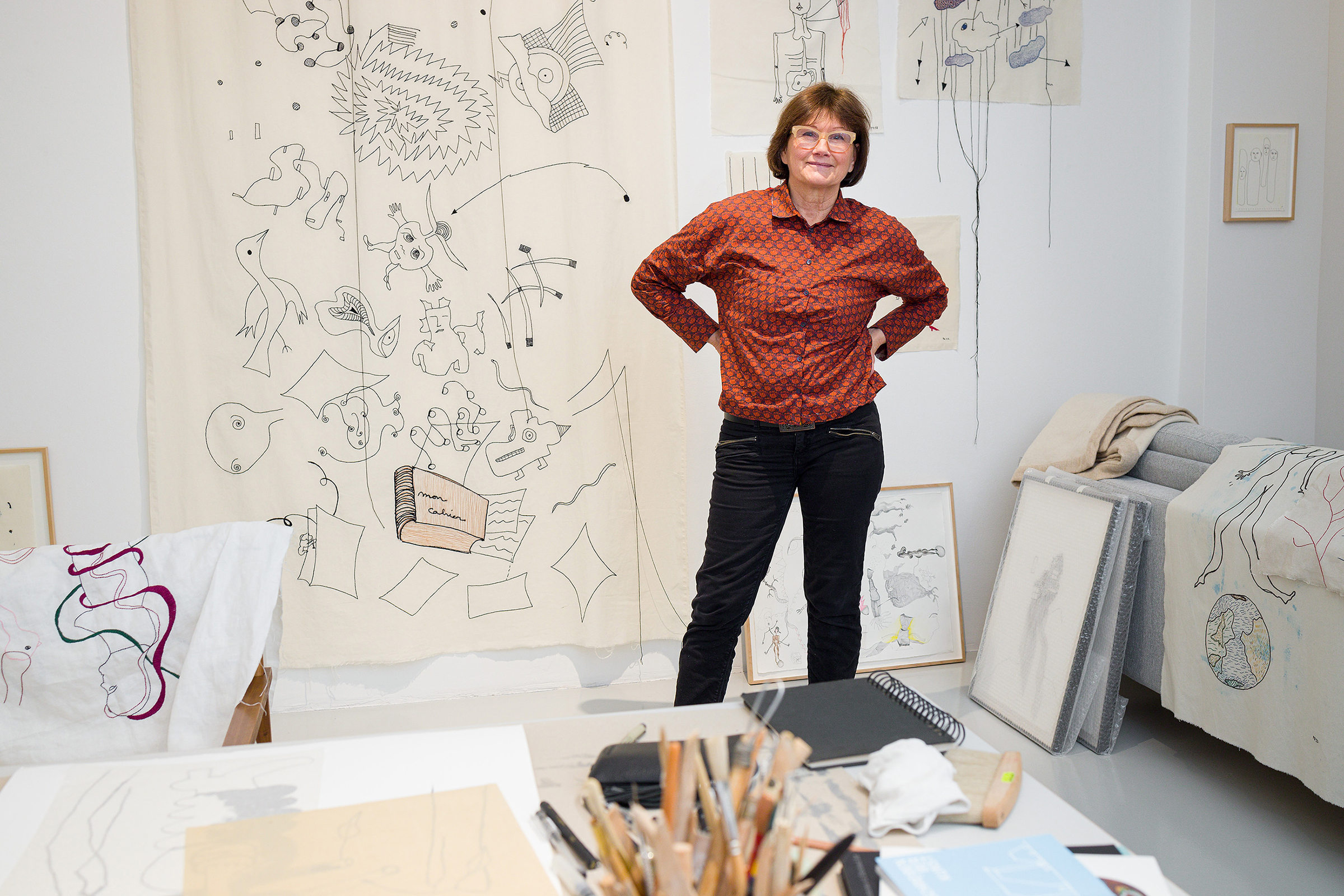
Houses are a recurrent motif in Patricia Dreyfus’s drawings – sometimes in the form of high-rise buildings, elsewhere as simple family homes in the way children paint them. In general, the motif belongs to the thematic complex of “women” or “femininity”. The drawing “Turbulenz-Zone” (Zone of turbulence) shows a naked female figure squatting on top of a somewhat crumpled block of flats; the figure is using the roof of the neighbouring building (which has been skewered by a rocket) as a makeshift tabletop to stand drinks on...
Here, phallic symbolism (skyscraper, rocket) collides with seductive femininity. Items of clothing are strewn on the ground – maybe the naked figure tore them off her body, maybe they fell off the washing line that was no longer able to withstand such “turbulence”. In “Der zwingende Abgang” (The imperative departure) a female body is being sucked away – it is already halfway to becoming a skeleton, and its bones are rapidly disappearing inside an object which simultaneously appears to be a vacuum cleaner, a coffin and an elongated block of flats. The female role evidently seems to be defined from the outside, by things and fixed moments of reality which – at least in Patricia Dreyfus’s drawings – gives rise to puzzling consequences, extending even to self-dissolution.
In dream interpretation, the house is an archetype commonly read as a symbol of the self and the soul of the dreamer, and stands for the way the subject “builds” his or her life. Freud ascribed the house to the woman, saw it as a symbolic synonym for the womb. It was the groundbreaking “house dream” dreamt by C. G. Jung in 1909 that sparked the disagreement between Freud and his follower. In the dream, Jung was wandering through various floors of a house when in the cellar he stumbled across walls from the Roman period, beneath which he found the remains of a primitive culture. This marked the discovery of the “collective unconscious”, whose existence Freud vehemently and persistently denied.
With her sculpture “Die schwarze Insel” (The black island), Patricia Dreyfus has formulated an image both for a present-day “collective unconscious” and the condition of our external world. A flat rectangular vessel (two metres long, one and a half metres wide) mounted on a plinth is filled with what seems to be jet black water, standing in which is a block of black polystyrene – a black island in a black ocean. Balancing on the ground of this polystyrene island laden with lumps and shards of coal is a house made of black cardboard, unstable and fragile, a place that can no longer serve anyone as a home. Patricia Dreyfus has created an image of the end of time, an island where death is ubiquitous. Memories of recent disasters are awakened, the oil disaster in the Gulf of Mexico, the tsunami and nuclear meltdown in Japan. We now have a notion of what a post-cataclysmic world would look like, and Dreyfus’s sculpture specifies this condition – even if newspapers and news agencies have long since turned their attention elsewhere. In 1922, T. S. Eliot undertook a similar act of “specification” in poetry. In “The burial of the dead”, the first section of his famous poem “The Waste Land”, he writes:
What are the roots that clutch, what branches grow
Out of this stony rubbish? Son of man,
You cannot say, or guess, for you know only
A heap of broken images, where the sun beats,
And the dead tree gives no shelter, the cricket no relief,
And the dry stone no sound of water.
This describes the external state of a barren and desolate world at the same time as the inner condition of the isolated and spiritually empty individual in the modern era. Eliot concludes this passage with the words: “I will show you fear in a handful of dust”. Black dust that harbours nothing but the mummified remains of nature and civilisation also blankets everything in Patricia Dreyfus’s sculpture. If fear is to be kept from having the last word, this dust might instead be read as ashes, allowing some promise of hope to be construed in this work. Ash also stands for cleansing, rebirth and fertility.
Art is entrusted with the task of finding imagery for the present. Yet in contrast to the images generated by contemporary news it has the capacity to transcend horror and lend it a poetic and, under certain circumstances, even an “edifying” form. Art thereby offers relief, yet without ever calling for an end to action and thinking. Patricia Dreyfus’s sculpture “The black island”, her drawings and head sculptures, all carry a warning: we still have a chance to be mindful of the category of humanity. But it is high time we are.
Hamburg, October 2011 I Translated by Matthew Partridge